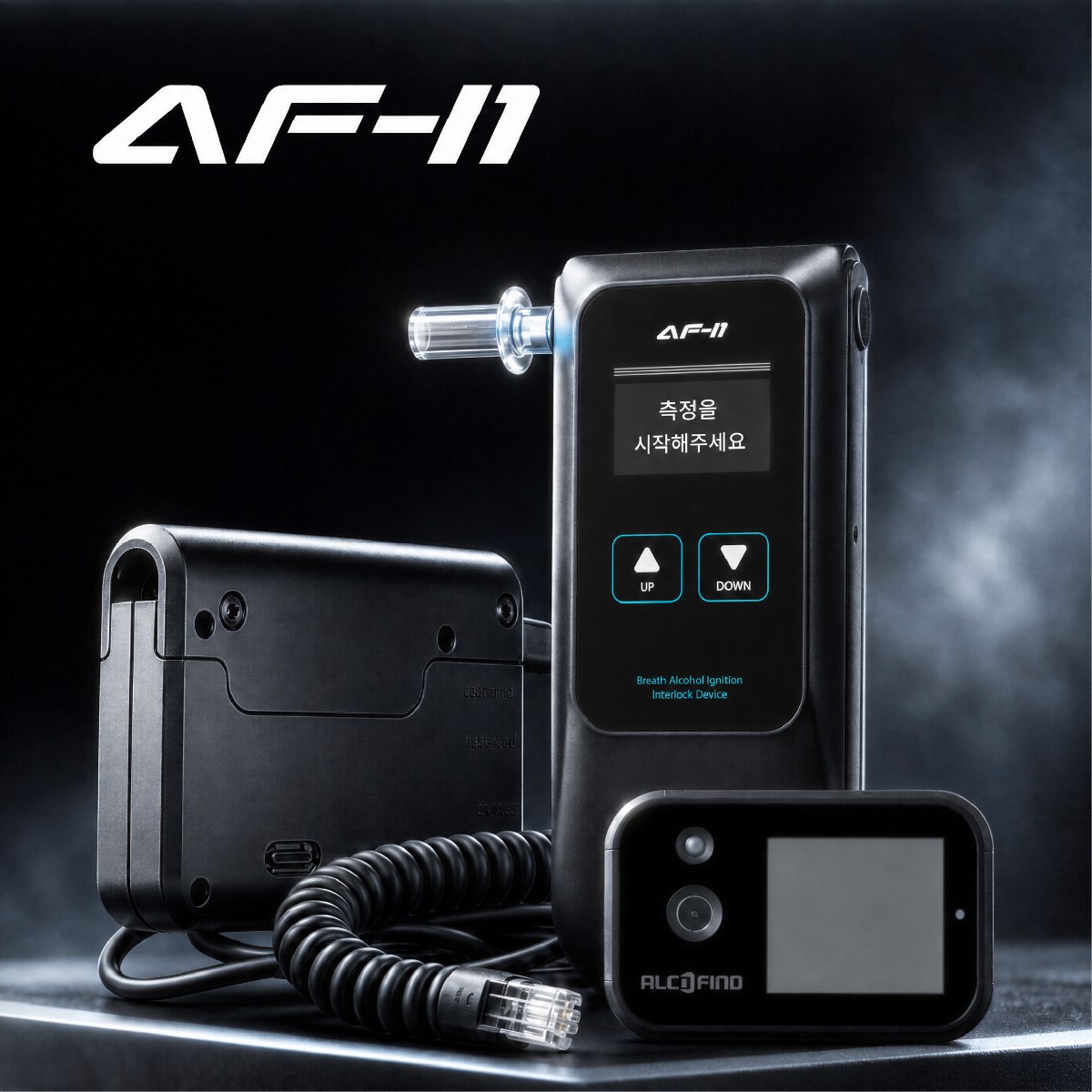
An interlock is an alcohol interlock that, when the driver takes a breath test before starting the vehicle, controls the start according to the result. If you only tell the drivers of vehicles getting the device that it is being installed, immediate questions remain: when to test on the first day of driving, what happens to dispatch if a test does not complete normally, and what to tell the shop when the vehicle goes in for maintenance. This kind of confusion arises even more easily in a vehicle shared by family members or a work vehicle used by several drivers in rotation.
A driver notice is less an announcement introducing the device's benefits and more a document that tells drivers when to stop during use and where to ask for help. For example, the AF-i1 consists of a handset that measures breath and a control box, a central processing unit connected to the vehicle, and it can store test results and vehicle start-related events. However, the notice should include only the actual configuration of the installed device and the support procedures the organization has set. If you answer the questions below in advance, drivers can ask for help through the set channels instead of operating the device on their own.
State clearly which vehicles are covered and when use begins
At the top of the notice, state which vehicles will have the device installed, from when drivers must use it, and when and where usage training will take place. If you use only a broad expression such as "scheduled for introduction," drivers will find it hard to tell whether the device applies to the vehicle they are driving today. It is clearer to give the vehicle number or internal identifier, the start date, and the training location and time together.
For shared vehicles, you also need to tell the person taking over the vehicle where to check that the device is installed and the guidance for that day's use. If what the dispatcher says differs from the driver document, information can be lost at handover. If the covered vehicles or start date have not yet been decided, rather than writing as though they were confirmed, it is appropriate to designate the department that will announce the confirmed details and when the announcement will be made.
Explain the steps when a test does not complete normally
When drivers encounter a failed test or a device alert, the first things they want to know are whether they can drive and what to do next. Rather than listing guesses at individual screen messages, the notice should state that if the test or start process does not complete normally, the trip is put on hold, and whom to contact and how. Limit retesting and button operation to what the installed device's user manual and the training cover.
As a hypothetical case, consider a driver about to start a morning dispatch who took a breath test but cannot tell whether it completed normally. What to record first is the vehicle identification, the time it happened, what the device displayed, and the circumstances at the time of the test. This is not information for concluding that the driver was at fault but facts that the fleet operations staff or service staff need to decide the order of support.
A possible action is to put the trip on hold, pass this information to the contact listed in the notice, and tell the dispatcher that the vehicle cannot be used on time. Do not present disassembling, removing, or changing the device or wiring on one's own as a solution. The completion criterion for this situation can be set as the point at which the person in charge has communicated the next step for that vehicle's operation or inspection and the driver has received that guidance.
Specify what information is stored and who reviews it for what work
What the device stores, and who looks at that data in what work, should be explained before rollout. The official AF-i1 guidance states that it stores interlock usage events such as vehicle ACC, engine start, test results, and tampering with date and time information, and that log events can be managed and downloaded with dedicated software. The items actually collected in the installed configuration, and the scope reviewed internally, need to be set out precisely and separately from this description of functions.
The notice should state the role responsible for viewing records, the purpose of viewing, and the contact channel through which drivers can ask questions about the records. The sentence "the manager will check" alone does not tell anyone who sees test results, or whether the same person also sees events related to vehicle maintenance. It is better to express it by dividing tasks and subjects, for example that fleet operations staff handle the data for dispatch and trip support, while records staff handle it to check stored events.
| Question drivers ask | Answer to include in the notice | Role responsible for the answer or action |
|---|---|---|
| From when do I test in this vehicle? | Covered vehicles, start date, training schedule | Fleet operations staff |
| What if the test process does not complete normally? | Criteria for holding the trip, order of contacts, support contact details | Operations or service staff |
| What is stored? | Items actually stored, purpose of viewing, how to ask questions | Records management staff |
| What about when the vehicle goes in for maintenance? | Whom to tell about the installed device before maintenance, and the order of contacts | Maintenance supervisor |
The answers in the table need to be aligned before distribution so that the relevant staff can explain them in the same way. For example, if a driver received the service contact details but the maintenance staff do not know a device is installed, the driver will find it hard to know which guidance to follow. Do not write undecided items as if they were confirmed policy; also give the contact point that will take questions until they are confirmed.
Decide in advance how maintenance and inspection are coordinated
When a vehicle is taken to a repair shop or a vehicle replacement is being considered, the fact that an interlock is installed must be passed to the person coordinating the maintenance work. The driver notice should include whom to contact before booking maintenance, what vehicle information to give the shop, and who coordinates checking the device's condition after the work. Without this item, drivers may hand over a vehicle without even knowing they should have mentioned that the device is fitted.
The AF-i1 is described as having inspection and calibration reminders. However, a reminder appearing does not mean the driver must handle scheduling, changes to vehicle assignment, and service requests alone. The organization should designate who receives reminders and who coordinates schedules, and drivers should be able to see in the notice which contact to inform when they notice a reminder.
Do not mix device functions with operating rules
What the product description presents, such as tamper detection and record storage, are functions the device can perform. On the other hand, who receives alerts, how to adjust dispatch for a vehicle whose test did not complete, and how far stored events will be reviewed are operating rules the organization sets. Mixing the two in one sentence can lead people to think the device's automatic functions are themselves the internal handling procedure.
Before distributing the notice, a good approach is to check whether the fleet operations, dispatch, maintenance, and records staff can all give the same answers to the questions in the table. When contact details change or vehicles are added, issue a new notice stating what changed and the effective date. Reflect questions that recur during actual use in the next revision, but rather than publicizing a particular driver's case, recast it as a situation that could happen to anyone; that makes the support procedure clearer.