Businesses, installers, and procurement staff reviewing materials on alcohol interlocks supplied overseas tend to think, when they see the same product name and a detailed feature table, that those specifications can be applied directly to devices for Korea's conditional driver's licenses. An alcohol interlock, or interlock, is a device connected to a vehicle to control engine starting based on the result of the driver's breath test. A device's performance and configuration are a starting point for comparison, but they do not in themselves mean that domestic procedures are satisfied.
An export catalog, current product information, a quote, and guidance on domestic procedures may look similar, but they are documents that answer different questions. Export materials describe the product and environment at the time of overseas supply, current supply materials show the device that will actually be delivered, and domestic procedure guidance deals with the installation and registration matters needed for a conditional license. So rather than copying export specifications as they are, it makes sense to compare the actual supply configuration and domestic procedural requirements separately.
Keep overseas supply history separate from domestic applicability
A record of use in an overseas government program, or experience supplying a particular country, can be reference material showing which markets a device has been provided to. However, that record alone does not mean the device has been recognized as a device for Korea's conditional license, or that domestic installation and registration procedures are complete. This is because overseas and domestic systems can differ in who they apply to, what documents must be submitted, and how devices are managed after fitting.
So in proposals or contract review documents, it is best to place overseas usage history under product introduction and leave domestic applicability as a separate review item. Do not turn wording such as "in use" from overseas materials into expressions that mean the outcome of a domestic procedure, such as "approved in Korea" or "can be registered in Korea." The latter expressions need separate confirmation regarding domestic procedures.
The product page describes the device's functions
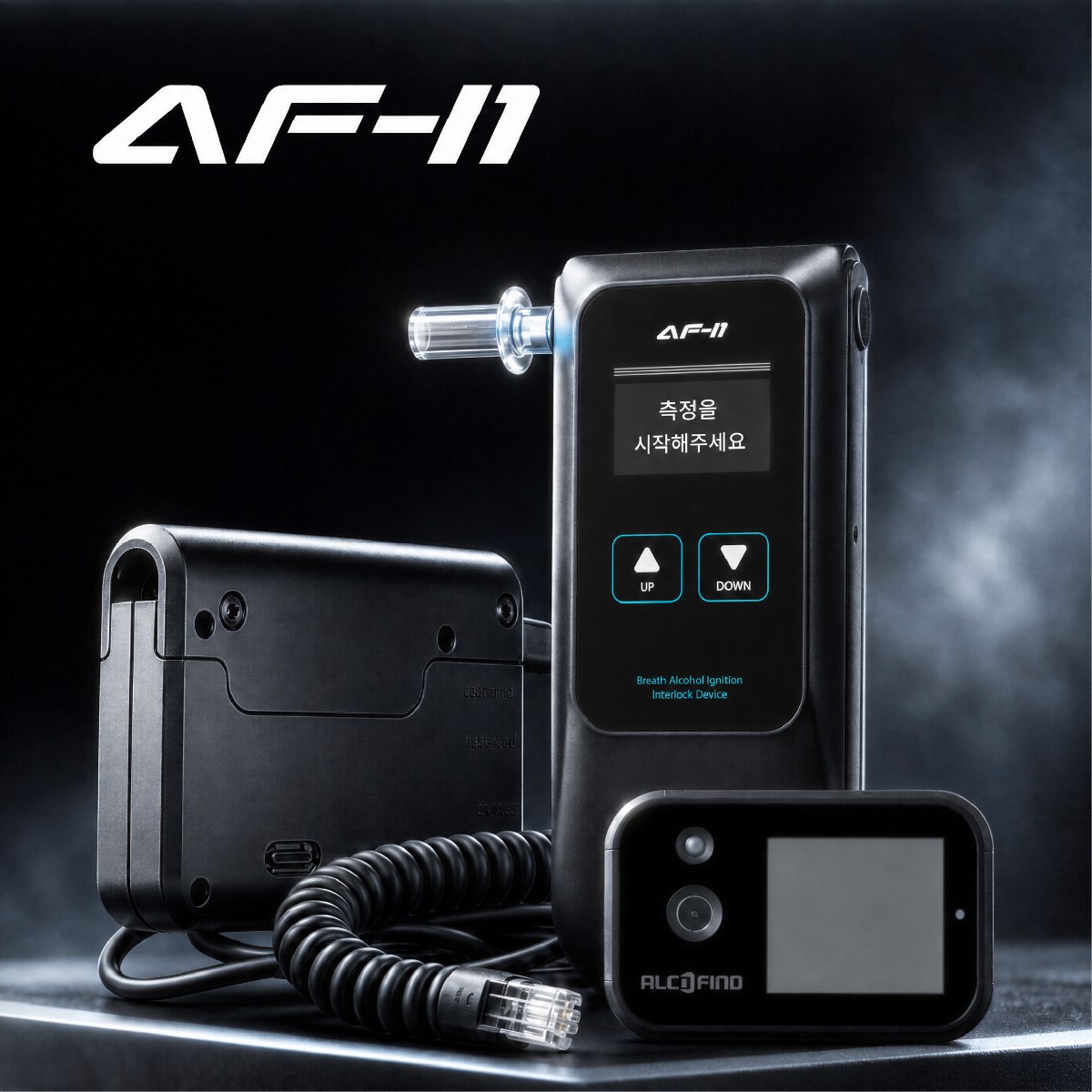
The current official AF-i1 product information introduces the handset and control box as components. The handset is the device the driver uses for the breath test, and the control box is the part connected to the vehicle that handles the device's operation. This information describes the device as designed to check the driver's blood alcohol concentration (BAC) and prevent the engine from starting if a set value is exceeded.
The official information also states that usage-related data can be managed and downloaded through dedicated software. It describes storing events related to device use, such as vehicle ACC, engine start, test results, and tampering, with date and time information. This is a basis for understanding what the device does and what configuration it is presented with. It is not a basis for knowing what documents those records serve as in Korea's conditional license procedure.
| What to compare | What to look at in the document | What to record after review |
|---|---|---|
| Export materials | Publication date, target country, model and options | That it is an overseas supply case, and its scope |
| Current supply materials | Model actually delivered, included components, software provided | Scope of supply in the quote and contract |
| Domestic procedure guidance | Matters needed for installation and registration, documents to submit | Items to compare against the product materials |
The reason for separating export materials from current supply materials is that, even under the same product name, the document date, options, and supply configuration may differ. If you apply the input voltage or the number of storable records written in an old catalog directly to the device in the latest quote, the documents may not match the product actually delivered. Do not pick and combine figures for convenience. Confirm the figures you need in the current materials that apply to the model you will actually supply.
Installation and registration questions differ from product questions
The statement that the device controls engine starting based on breath test results is a description of the device's function. On the other hand, what registration procedure follows after a device is fitted to a vehicle under a conditional license, and what documents are submitted, is a question about how the system is run. If you try to answer both questions with one product page or export catalog, functional descriptions and administrative requirements get mixed together.
In practice, you can split the questions: confirm with the supplier the models that can actually be provided, the components, the applicable product materials, and the scope of installation support, and confirm with the authority that provides guidance on domestic procedures the devices and documents needed for installation and registration. Even if the two answers look different, that is not immediately a conflict. First distinguish which question each answer addresses, then check whether the actual supply configuration can satisfy the items to be confirmed in the domestic procedure.
Find the gaps in the documents through a hypothetical case
For example, assume a staff member received an old catalog listing European supply history together with a quote for the domestic market. The catalog lists many features and figures, but the quote has only a model name and does not specify the handset, control box, software, or scope of installation support. The facts to observe in this situation are that overseas materials exist and that the configuration actually to be supplied domestically has not been fixed in writing.
This observation leads to the interpretation that the overseas catalog alone cannot establish suitability for Korea's conditional license. One possible action is to ask the supplier to link the version of the model actually to be delivered, the included components, and the applicable product materials to the quote. At the same time, you can confirm the installation- and registration-related matters required by the domestic procedure and match them item by item with the materials the supplier provides.
In this case, the completion standard is not copying figures from the old catalog into domestic documents. It is a state in which the model, configuration, and applicable materials of the device actually to be delivered are clearly stated in the documents, and the matters to be confirmed separately in Korea's conditional license procedure have been organized. Only by not writing unconfirmed overseas settings or features into a domestic contract as default specifications can the next installation and registration review continue on the same basis.
Write the scope of supply, not introductory material, into the contract
You can consider stating specifically in quotes and acceptance documents the model to be provided, the included components, and the scope of installation support. Even if the official AF-i1 product information introduces the handset and control box together, what is included in a particular transaction must be confirmed in that quote and contract. You cannot assume that every item on a product introduction page is automatically included in each contract.
Even if the device is described as storing usage-related data, it is best to write that function and any documents the domestic procedure may require separately. Link product functions to official product materials, the actual delivery scope to the quote and contract, and the requirements of the conditional license procedure to official guidance on the system. Dividing the roles of documents this way reduces the chance of repurposing export specifications for Korea's conditional license without a basis.
※ This article provides general information and is not legal advice on any individual case. Consult a lawyer or other professional about specific situations. Laws may be amended, so check the latest text at the Korea Law Information Center.